

AI is changing the division of labor in finance.
Work that once required people to create, classify, approve, reconcile, and route financial transactions is increasingly being handled by automated workflows and AI agents. SAP, Oracle, Workday, and other major systems of record are embedding these capabilities directly into financial processes.
That creates an obvious opportunity for finance teams: more work can happen faster, with less manual effort.
It also creates a less obvious problem.
The faster financial execution becomes, the harder it becomes for human oversight to keep pace.
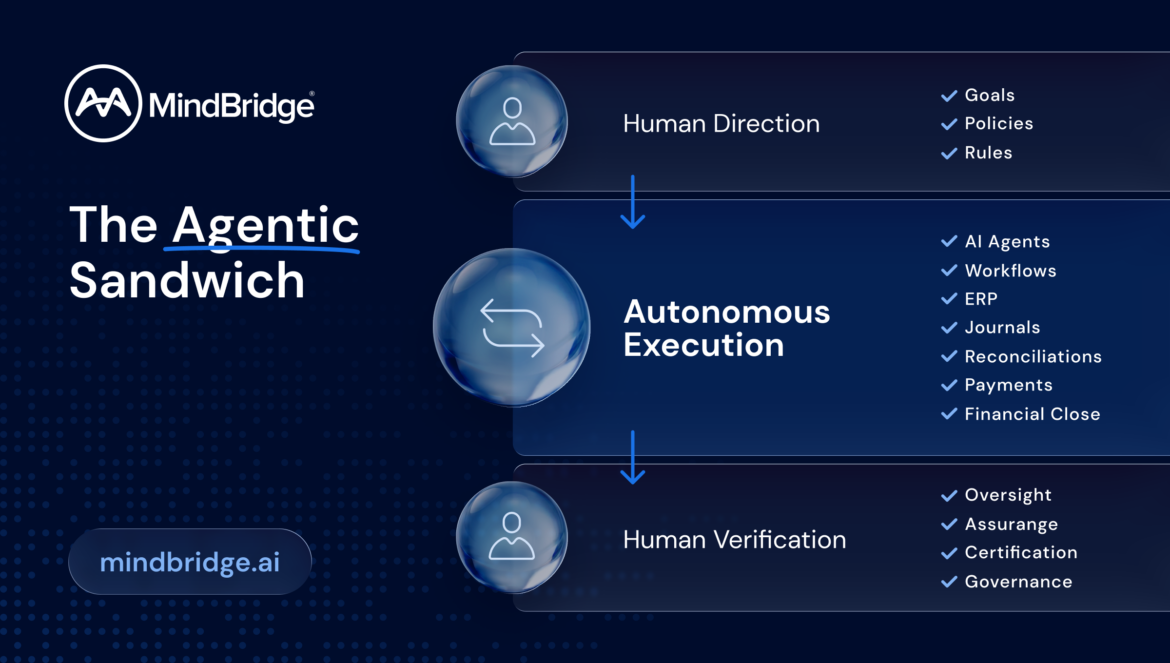
The Agentic Sandwich
One way to understand the emerging operating model is as an agentic sandwich.
At the top, humans provide direction. They establish the goals, policies, rules, and boundaries that determine what should happen.
In the middle, an increasingly large layer of autonomous execution does the work. AI agents and automated workflows operate across ERP systems, journal entries, reconciliations, payments, financial close, and other processes.
At the bottom, humans remain responsible for verification. Finance leaders still have to determine whether the work was performed correctly, whether the resulting financial activity can be trusted, and whether something requires intervention.
AI changes who performs the work. It does not transfer accountability for the outcome.
That distinction is particularly important in finance. A CFO can delegate execution to automation, but accountability for the integrity of the numbers remains with the organization.
Execution is scaling faster than verification
This creates an asymmetry.
AI can execute thousands or millions of actions without a corresponding increase in human capacity. A finance team cannot manually review transactions at the same speed that automated systems can create, classify, approve, or modify them.
Economists Christian Catalini, Xiang Hui, and Jane Wu describe this broader shift in Some Simple Economics of AGI: as AI reduces the cost of execution, verification becomes increasingly scarce. In other words, producing an output becomes easier. Establishing whether that output can be trusted becomes more valuable.
For finance, that gap has practical consequences.
A flawed instruction, unexpected pattern, or logic error inside an automated workflow can move through connected financial systems before a periodic review catches it. And the problem does not have to look like an obvious control failure. It may appear as normal financial activity occurring at abnormal scale, small deviations compounding across transactions, or individually plausible entries producing a misleading result.
Traditional controls remain necessary. But an oversight model built around periodic review, sampling, and human attention cannot simply scale in proportion to autonomous execution.
Autonomous finance needs independent oversight
The answer is not to put people back into every step of execution. That would eliminate much of the value automation is meant to create.
Instead, the oversight architecture has to evolve alongside the execution architecture.
Autonomous Financial Oversight (AFO) is the independent layer that governs autonomous finance. It monitors financial activity across systems of record, detects risk, explains findings, and enables governed action before exposure becomes material.
Independence is critical. The system executing financial activity should not be the only system responsible for determining whether that activity is appropriate. As the MindBridge architecture illustrates, oversight sits above and across the systems doing the work rather than relying on each executing system to validate itself.
That changes the role of human verification.
Finance professionals do not need to inspect every transaction themselves. They need oversight that can continuously evaluate the full population, identify where risk is emerging, explain why something deserves attention, and direct human judgment toward the activity that matters.
The human remains accountable. But human attention becomes focused rather than exhaustive.
The architecture of autonomous finance is taking shape
That brings us back to the Agentic Sandwich.
Human direction sits above. Autonomous execution expands through the middle. Human verification remains below.
As that middle layer grows, the question for finance leaders is not simply how much work AI can perform. It is whether their ability to oversee that work is scaling with it.
MindBridge provides the independent oversight layer for that emerging model through Autonomous Financial Oversight, continuously analyzing 100% of financial transactions across systems of record to detect risk, explain what matters, and enable governed action.
The Agentic Sandwich is not an argument for less automation. It is an argument for oversight that can keep up with it.