



Retail finance operates at an extraordinary scale, with millions of transactions flowing each day across point-of-sale systems, e-commerce platforms, payment providers, and supply chain networks. Each transaction generates data that must be reconciled into a single, accurate financial record.
This complexity is not new, but it is becoming harder to manage. Recent survey data shows that retail finance teams are experiencing more disruption from data issues than any other industry studied, and the gap is significant.
Disruption at Scale
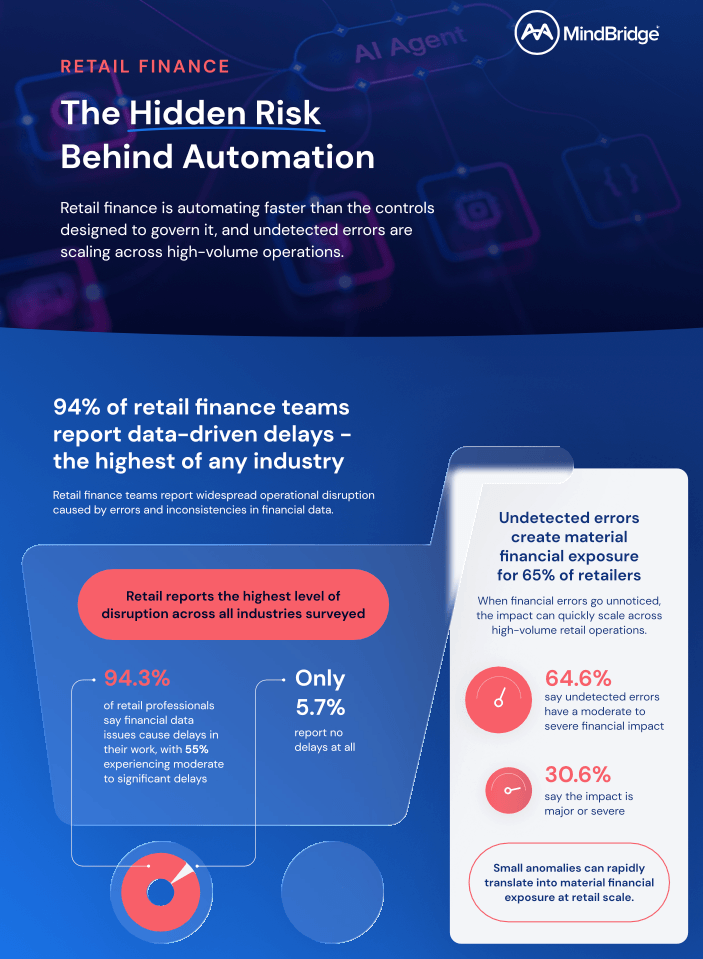
Among retail professionals recently surveyed, 94.3% report delays caused by data issues, with more than half describing those delays as moderate to significant. Only 5.7% report no disruption at all, making retail the most affected sector in the study.
For finance teams working within tight reporting timelines, this level of disruption has clear consequences. Reconciliations take longer, close processes become more complex, and teams spend more time investigating discrepancies across systems rather than focusing on analysis.
The challenge is not a lack of data, but the difficulty of trusting and validating it at scale.
Download the full survey infographic: See a visual breakdown of how data issues impact retail finance teams.
When Small Issues Multiply
In retail environments, small problems rarely stay small. A configuration error or data inconsistency can spread across thousands or even millions of transactions before it is detected.
This dynamic is reflected in the data: 64.6% of respondents report a moderate to severe financial impact from undetected errors, including 30.6% who describe it as major or severe. At this scale, even low-probability errors can quickly become material.
Automation and the Visibility Gap
Retail organizations are investing heavily in automation to manage volume and improve efficiency, and teams see clear benefits in accuracy, control, and reduced manual work.
However, as processes accelerate, human visibility into transactions decreases, allowing issues that might once have been caught through manual review to move through systems undetected. Already, 43.5% of retail leaders express concern that errors could go unnoticed as automation expands.
Rethinking Financial Oversight
Traditional control models, built on sampling and periodic review, are increasingly misaligned with the speed and scale of modern retail finance. Risks now emerge across patterns and systems, often becoming visible only after they have spread.
As a result, many organizations are shifting toward continuous monitoring of financial activity to identify issues earlier and maintain control across the entire transaction population.
In retail, financial risk rarely appears as a single event. It builds gradually, embedded within millions of transactions moving through the system every day.
The question is not whether data issues exist. It’s whether your current controls can keep pace with the scale and speed of your operations. Download the full Retail survey infographic to see how leading finance teams are approaching continuous financial oversight in automated environments.