

Accounting firms are facing increasing pressure from larger datasets, tighter timelines, rising client expectations, and ongoing staffing constraints.
As engagement complexity grows, many firms are rethinking how review and audit workflows scale without sacrificing quality or defensibility.
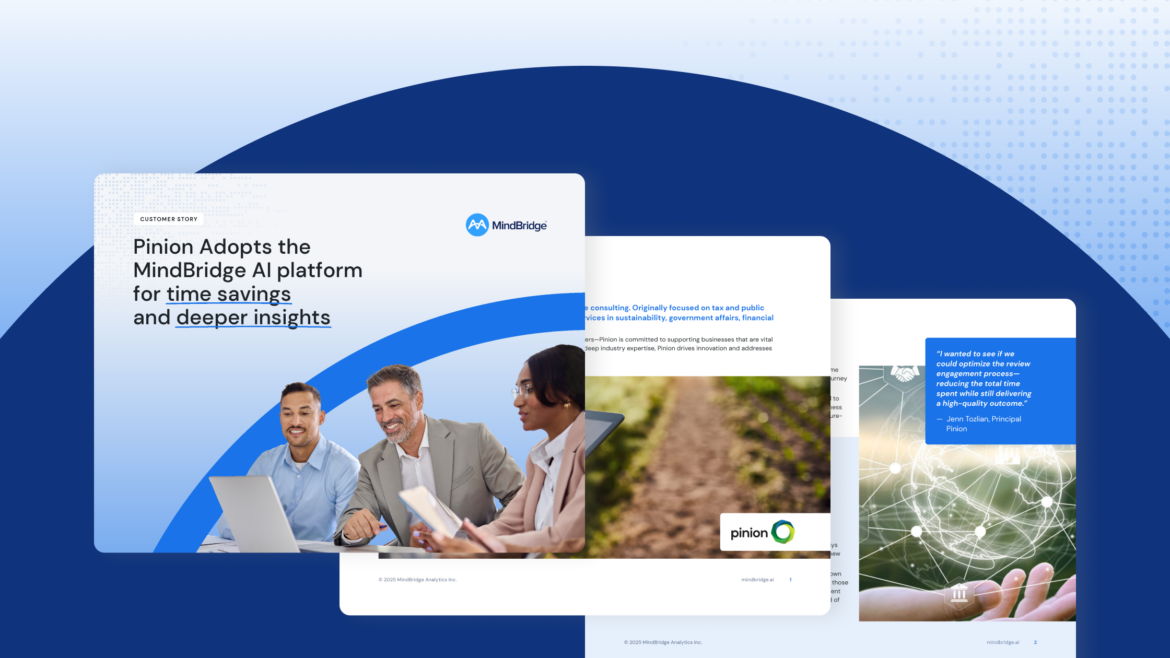
One example comes from Pinion, which used MindBridge during a complex first-year review engagement to reduce expected engagement hours by 20–25% while improving visibility into the client’s business and reducing operational friction.
The broader story is not simply about efficiency gains.
It reflects how modern engagement workflows are beginning to reshape how accounting firms deliver audit and advisory services.
What the Pinion Engagement Reveals
Pinion’s experience reflects how firms are beginning to modernize engagement delivery in increasingly complex review environments.
After initially adopting MindBridge for external auditing, the firm expanded usage into review engagement workflows as part of a broader modernization initiative.
During a particularly complex first-year engagement, the team used MindBridge’s risk intelligence capabilities to streamline analysis, improve visibility into the client’s business, and reduce expected engagement hours by 20–25%.
The impact extended beyond efficiency gains. The engagement team gained clearer visibility into operational trends, enabling more informed client discussions throughout the engagement process.
The client — previously frustrated by poor timelines and excessive back-and-forth with other firms — also experienced a smoother engagement process with less operational friction.
That shift matters because firms are increasingly discovering that modern engagement workflows can improve both operational efficiency and client experience at the same time.
Why First-Year Engagements Matter
First-year engagements are often the most operationally demanding because they involve greater onboarding complexity, unfamiliar financial environments, and significantly more manual review work.
That is why Pinion’s success during a first-year engagement is particularly important.
Reducing engagement hours while simultaneously improving engagement visibility and client satisfaction demonstrates how modern review workflows can improve engagement execution.
For accounting firms facing increasing pressure to scale efficiently, this represents a meaningful operational advantage.
What Leading Firms Should Consider Next
For firms evaluating how to modernize engagement delivery, first-year engagements and high-volume review environments are often the clearest place to start.
The goal is not simply faster engagements.
It is creating a more scalable and defensible engagement model built around continuous analysis, earlier risk detection, and deeper financial visibility across increasingly complex client environments.
See How Pinion Used MindBridge to Modernize Engagement Delivery
Read the full Pinion customer story to explore how the firm used MindBridge to reduce engagement hours, improve engagement visibility, and deliver a better client experience during a complex first-year engagement.
FAQ: AI in Audit and Review Engagements
How are accounting firms using AI in review engagements?
Accounting firms are increasingly using AI-driven financial analysis platforms like MindBridge to continuously analyze large transaction populations, identify elevated-risk areas earlier, reduce manual review effort, and improve visibility across complex review and audit engagements.
Why are first-year review engagements more difficult?
First-year review engagements often involve unfamiliar financial environments, greater onboarding complexity, additional communication demands, and significantly more manual review work. These engagements are also more difficult to standardize because teams have less historical engagement knowledge and fewer established workflows.
How can AI improve audit and review engagement efficiency?
AI can help accounting firms streamline review workflows by continuously analyzing financial data, surfacing operational anomalies earlier, and reducing repetitive manual procedures. This allows engagement teams to spend more time on professional judgment, risk assessment, and client discussions rather than manual transaction review.
What should accounting firms look for in AI review engagement platforms?
Accounting firms evaluating AI platforms should look for capabilities that improve engagement visibility, support full-population financial analysis, surface elevated-risk transactions, and help teams reduce operational friction without sacrificing defensibility or engagement quality.