
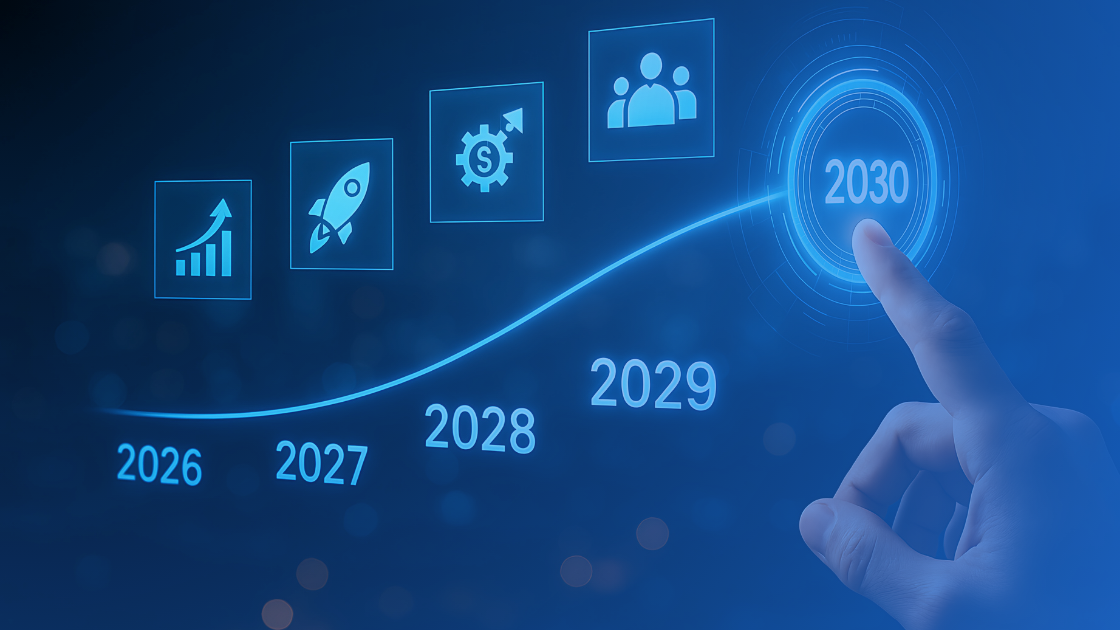

AI in finance operations is not only changing how work gets done. It is redefining what “financial work” actually is.
The changes taking place across finance today are often described in terms of automation and efficiency. But that framing misses what is actually happening.
This is not simply a faster version of existing processes.
It is the beginning of a different operating model.
Finance is shifting beyond process execution
For decades, finance has been defined by the processes it executes.
Transactions are recorded. Reconciliations are completed. Reports are produced. Controls are applied at defined points in time.
Even as systems improved, the structure remained the same.
That structure is now changing.
According to Gartner® Finance 2030: The Future of Finance Technology, by 2030, finance teams will operate in a technology environment where conversational interfaces, AI-powered models, and intelligent agents redefine how finance work is performed.
The implication is not incremental improvement.
It is a shift away from process-driven work toward systems that generate, interpret, and act on financial data continuously.
From workflows to tools, models, and agents
As AI capabilities mature, finance is no longer limited to executing predefined workflows.
Instead, teams will increasingly build and rely on:
- Models that simulate outcomes and guide decisions in real time
- Agents that execute tasks across systems without direct intervention
- Tools that allow finance users to generate analysis, applications, and workflows on demand
In this environment, financial work becomes less about completing steps and more about configuring, evaluating, and governing the systems that perform them.
The role of finance begins to move up the stack.
Interaction with finance systems will fundamentally change
The interface to finance technology is also evolving.
Rather than navigating systems through predefined paths, users will increasingly interact with financial data through natural language.
They will ask questions, run scenarios, and initiate actions conversationally, with underlying systems interpreting intent and executing tasks.
What currently requires multiple systems, queries, and manual intervention will happen in a single interaction.
This changes not only how work is done, but how quickly insight can be generated and applied.
Scale introduces a new level of dependency on governance
As these capabilities expand, so does the level of reliance on them.
- More decisions will be influenced by models.
- More processes will be executed by agents.
- More outputs will be generated without direct human intervention.
This creates a new dependency inside the finance function.
Not just on systems themselves, but on the ability to govern how those systems operate.
Gartner’s research is clear on this point: as AI becomes embedded across finance, governance, monitoring, and oversight become foundational to scaling these capabilities safely.
The future is already forming
This future state is not a distant projection.
Many of the capabilities described—AI-assisted analysis, agent-driven automation, real-time modeling—are already emerging inside existing finance environments.
What changes between now and 2030 is not whether they exist.
It is the extent to which they define how finance operates.
Organizations that treat these developments as isolated innovations will struggle to keep pace.
Those who recognize the shift early will be better positioned to shape how their finance function evolves.