

The workflow completed. Every approval passed. The numbers reconciled.
And the financial risk went undetected.
That is one of the more difficult challenges emerging as AI agents and automated workflows take on a greater share of financial execution. A transaction can satisfy every programmed rule and still contribute to a pattern of activity that threatens financial integrity.
For CFOs, the concern extends beyond whether automation is working as intended. It is whether the organization can independently evaluate the financial outcomes that automation produces.
That distinction sits at the center of the Governance Gap.
What is the Governance Gap in finance?
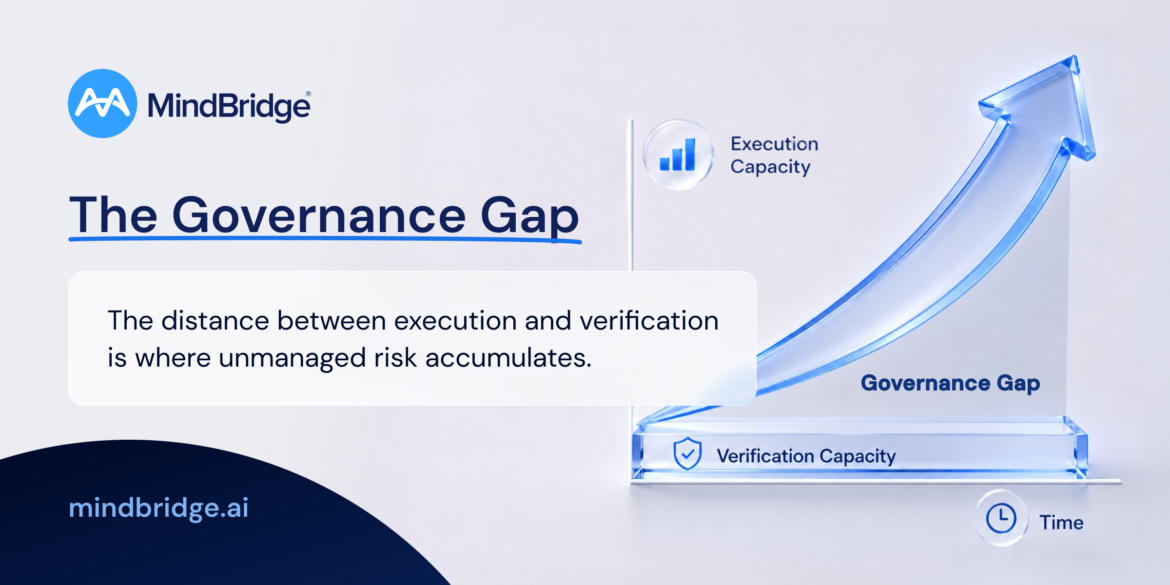
The Governance Gap is the widening distance between an organization’s capacity to execute financial activity and its ability to independently verify and govern the results.
As AI expands the volume and speed of financial execution, oversight does not necessarily scale at the same rate. Many finance teams still depend on periodic reviews, transaction sampling, predefined exceptions, and human investigation to identify potential problems.
Those methods remain valuable. But they were developed for an environment in which people performed much of the financial work, and the pace of execution was more closely tied to human capacity.
AI changes that relationship. An automated workflow can process thousands of transactions without requiring thousands of additional reviews. When verification capacity remains relatively unchanged, more financial activity can occur between the moment risk emerges and the moment someone identifies it.
The Governance Gap is the exposure created by that imbalance.
When a transaction passes the rules, but the risk remains
Consider an automated accounts payable process that validates invoices, verifies approval thresholds, and routes payments in accordance with established policies.
Each transaction may be processed correctly. Yet across business units, the same supplier could appear under slightly different vendor records, or a series of payments could exhibit unusual patterns that are difficult to identify within any single workflow.
The issue is not necessarily an individual payment that violates a rule. It is the relationship between transactions.
Financial close presents a similar challenge. Journal entries may be balanced and follow authorized posting procedures, while unusual accrual timing, repeated adjustments, or cross-entity patterns compromise the integrity of reported results.
These are illustrative scenarios, but the underlying risks are familiar to finance teams. Duplicate payments, approval-threshold splitting, unusual journal activity, and accounting irregularities can remain difficult to identify when financial information is fragmented across systems.
As automation expands, these patterns can develop across a much larger transaction population before they are examined.
For a CFO or Controller, the consequences can extend beyond an operational exception. Unidentified activity may affect working capital, reported earnings, the reliability of the close, or the organization’s ability to explain its financial position.
A completed workflow is not the same thing as a verified financial outcome.
Why existing financial controls cannot close the gap alone
Financial controls are designed to prevent and detect problems. Approval requirements, segregation of duties, reconciliations, and system-level validation remain essential to financial integrity.
But different mechanisms answer different questions.
An approval rule can determine whether a payment meets an established threshold. A reconciliation can establish whether two balances agree. A periodic review can evaluate the transactions selected for examination.
None of these activities, on its own, establishes that the entire population of financial activity is free from emerging risk.
This becomes especially important when automated workflows operate across multiple systems of record. A pattern that appears ordinary within one application may become unusual when evaluated across suppliers, entities, accounts, or reporting periods.
The challenge is therefore not simply to add more rules or increase the number of manual reviews. Those approaches may improve particular controls, but they do not necessarily address the architectural imbalance between execution and verification.
The more financial execution scales, the more important it becomes to evaluate financial outcomes independently of the systems producing them.
What closing the Governance Gap requires
Closing the Governance Gap does not mean returning finance to manual execution or requiring people to inspect every transaction.
It means expanding oversight capacity alongside automation.
Finance teams need visibility across the full transaction population, including activity distributed across different systems of record. They need to identify unusual behavior and emerging patterns without relying exclusively on predefined rules. And when something warrants investigation, they need evidence that explains what happened, why it matters, and where action is required.
Independence is equally important. The systems executing financial transactions can enforce embedded controls, but independent oversight must be able to evaluate the resulting activity across workflows and applications.
This is the role of Autonomous Financial Oversight (AFO).
AFO provides an independent oversight layer for autonomous finance. It continuously analyzes financial activity across systems of record, detects risk at the transaction level, produces explainable findings, and enables governed action before exposures become material.
Rather than replacing established financial controls, it complements them by evaluating financial activity beyond the boundaries of individual execution systems.
MindBridge is the leader in Autonomous Financial Oversight, providing continuous analysis of 100% of financial transactions across connected systems of record. Its independent oversight capabilities help finance teams detect unusual activity, understand the underlying risk, and direct attention toward findings that require investigation or action.
Financial execution is only half the equation
The value of AI in finance will continue to be measured through faster processes, greater capacity, and reduced manual effort. Those improvements matter, but they tell only part of the story.
A finance function can become more efficient without becoming more effective at detecting financial risk. And as transaction volumes grow, the consequences of delayed detection can grow with them.
For CFOs, the question is whether their oversight architecture can provide the same breadth of visibility into financial outcomes that automation provides into execution.
That requires looking beyond whether individual workflows are functioning correctly and asking whether the organization can identify, explain, and address risk across the financial population.
The real measure of progress is not simply how much financial work can be automated. It is how much of that work the organization can independently oversee.