

An invoice can pass its approval checks and still be part of a duplicate payment pattern. A journal entry can be valid on its own but unusual when compared with thousands of others. A financial workflow can operate exactly as designed while risk develops beyond the transactions it was built to evaluate.
These are familiar challenges for finance teams. As AI agents and automated workflows take on more financial activity, they become more consequential. Faster processing increases the volume of transactions moving through financial systems, but it does not automatically improve an organization’s ability to detect errors, fraud indicators, or emerging patterns of financial risk.
This raises an architectural question: Where should financial risk detection sit when execution is increasingly automated?
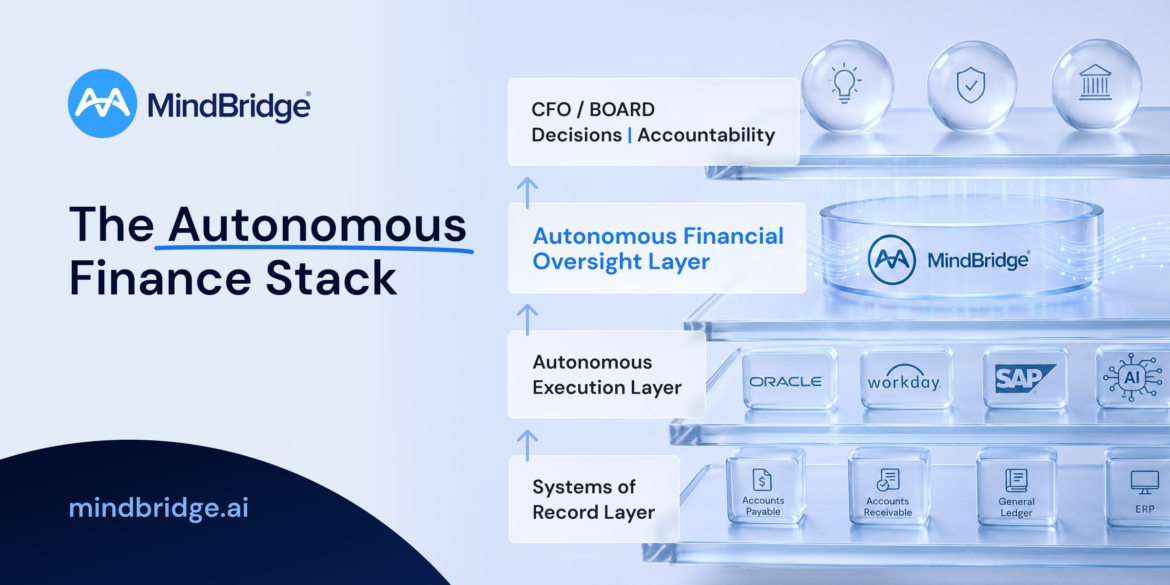
The Autonomous Finance Stack offers a way to distinguish the responsibilities of financial systems, automated execution, independent oversight, and executive accountability.
What is the Autonomous Finance Stack?
The Autonomous Finance Stack is a conceptual model for organizing financial operations into four distinct layers: systems of record, autonomous execution, Autonomous Financial Oversight, and CFO and board accountability.
Each layer serves a different purpose. Systems of record maintain financial data. Execution systems process financial activity. Independent oversight evaluates that activity for anomalies and risk. Finance leaders use the resulting evidence to make decisions and remain accountable for financial integrity.
The distinction matters because executing a financial transaction and independently evaluating its risk are different responsibilities. Combining them within the same workflow can leave finance leaders dependent on the checks that workflow was designed to perform.
Four layers, four different responsibilities
1. Systems of record: Where financial activity is captured
General ledgers, accounts payable and receivable systems, and enterprise resource planning platforms hold the financial records organizations rely on for reporting and operations.
They provide the underlying transaction data, account balances, and financial history needed to understand what has occurred.
But having complete records does not necessarily mean every unusual pattern has been identified. A transaction may be accurately recorded while still warranting investigation because of its timing, amount, relationship to other transactions, or departure from expected behavior.
2. Autonomous execution: Where financial work gets done
Automation already supports activities such as invoice processing, payment workflows, reconciliations, and journal preparation. AI agents are expanding the range of financial tasks that systems can perform with less manual involvement.
These workflows may apply approval requirements, validation checks, and other controls. Such checks remain essential, but they generally assess activity against defined conditions.
Consider an accounts payable process that checks invoice fields, verifies required approvals, and releases eligible payments. Those steps can function correctly while unusual payment patterns develop across vendors, business units, or periods.
The issue is not necessarily a failed workflow. It is that a workflow’s own checks may not be sufficient to identify every financial risk.
3. Autonomous Financial Oversight: Where anomalies and risk are independently evaluated
This is the layer that examines financial activity beyond the requirements of individual execution workflows.
Autonomous Financial Oversight (AFO) continuously analyzes financial transactions across systems of record to detect anomalies, identify emerging risks, explain findings, and support governed action.
That includes risks such as duplicate payments, unusual vendor activity, unexpected journal entries, and transaction patterns that may indicate errors, fraud, or financial leakage.
MindBridge provides this independent oversight layer. Its specialized AI engine analyzes full populations of financial transactions and identifies activity that warrants closer examination. Explainable findings help finance teams understand why particular transactions or patterns have been flagged, prioritize investigation, and determine an appropriate response.
An anomaly is not automatically evidence of fraud or an accounting error. It is a signal that requires context and judgment. That distinction is fundamental to effective oversight.
Rather than replacing approvals, reconciliations, or existing financial controls, independent oversight adds a broader view of risk across the financial activity those processes generate.
4. CFO and board: Where accountability remains
Greater autonomy in financial execution does not transfer accountability from finance leadership to the systems performing the work.
CFOs and Controllers remain responsible for financial integrity, while boards retain their governance responsibilities. They need evidence that financial activity is operating as intended and that material risks can be identified, investigated, and addressed.
Independent oversight supports that responsibility by making unusual activity and emerging exposure more visible. It does not replace executive judgment or automatically determine how every finding should be resolved.
Why existing financial controls are not enough on their own
Financial controls and independent oversight perform related but distinct functions.
A control is designed to address a defined risk. An approval threshold, for example, may require additional authorization for payments above a specified amount. A reconciliation may identify differences between financial records.
Those activities remain necessary. But financial risk does not always appear as a direct violation of an established rule.
A series of individually approved payments may form an unusual pattern. Journal entries may meet posting requirements while showing unexpected concentrations near period-end. A vendor’s activity may change significantly without triggering a workflow exception.
Identifying these patterns requires analysis of financial activity beyond individual approval or validation events.
That is why independent oversight belongs above and across systems of record and execution workflows. It complements embedded controls by examining the resulting financial activity for risks that those controls may not have been designed to detect.
What independent oversight looks like in practice
The value of this architecture becomes clearer in two areas of enterprise finance.
Spend integrity. Finance teams need to identify potential duplicate payments, unusual vendor behavior, policy violations, and other indicators of financial leakage. Analyzing transaction populations helps reveal patterns that may be difficult to recognize when reviewing individual invoices or payments.
Financial close. Controllers need confidence in journal entries, general ledger activity, and other high-risk accounting processes before reporting is finalized. Anomaly detection can direct attention toward unusual postings, unexpected account activity, and entries that warrant further review.
In both cases, the objective is not to automate every financial judgment. It is to give finance teams a clearer view of where risk may exist so they can investigate and act.
Organizations can begin with a high-impact process and expand oversight as their needs evolve. The underlying principle remains the same: financial risk should be evaluated independently of the workflows producing the activity.
Building financial autonomy without losing accountability
The Autonomous Finance Stack is not a prescription for four separate applications or vendors. Enterprise platforms can serve multiple functions, and the boundaries between systems of record and execution are not always rigid.
The model distinguishes responsibilities, not necessarily technology products.
As financial execution becomes more automated, organizations still need reliable records, effective controls, independent risk detection, and accountable decision-makers. The architecture works when those responsibilities reinforce one another without being confused.
For CFOs, the question is therefore not simply how much financial work can be automated. It is whether the organization can detect and explain financial risk as that work expands.
MindBridge, the leader in Autonomous Financial Oversight, provides the independent oversight layer that connects financial risk detection with explainable findings and governed action.
Learn more about Autonomous Financial Oversight and how independent oversight supports financial integrity across increasingly automated operations.