




Manufacturers have spent the past decade investing heavily in automation, advanced analytics, and digital operations. Finance teams are now expected to close faster, operate more efficiently, and deliver deeper insight into performance.
But for many CFOs, progress is being slowed by a less visible constraint: data issues.
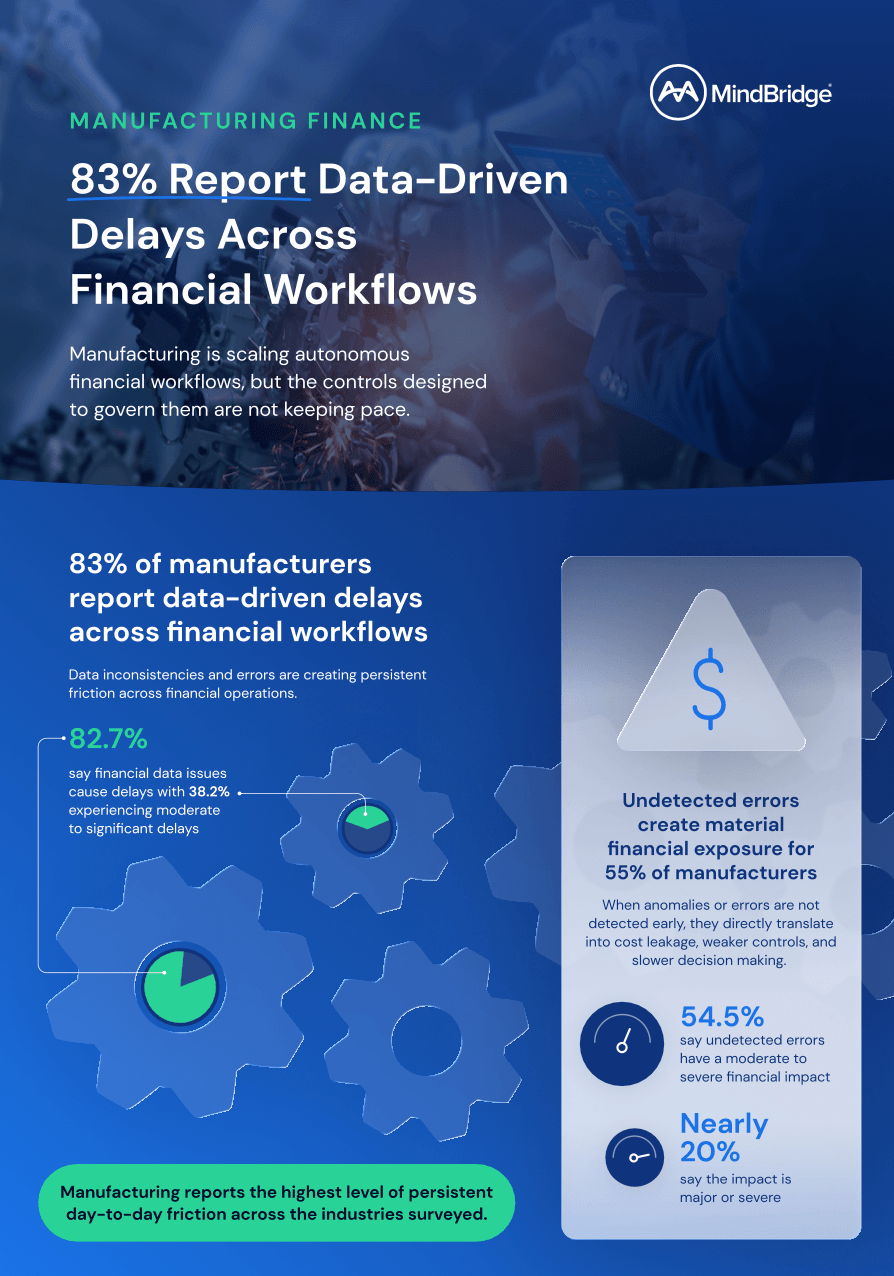
Recent survey data underscores how pervasive the issue has become. Among manufacturing finance professionals, 82.7% report delays caused by data issues, with nearly 40% describing those delays as moderate to significant. What was once considered operational friction is now a material barrier to performance.
Efficiency Meets Friction
Manufacturing finance teams operate across highly complex environments. ERP systems, procurement platforms, supply chain applications, and production systems all generate financial data that must ultimately align.
When they don’t, the impact is significant.
Download the full survey infographic: A visual breakdown of how data issues are impacting manufacturing finance teams.
In manufacturing environments, small data issues rarely stay that way.
A misclassified transaction, duplicate record, or incorrect system mapping can quickly propagate across thousands of entries before detection. As operations scale, so does the reach and impact of these errors.
This dynamic is reflected in the survey data:
- 54.5% of respondents report moderate to severe financial impact from undetected errors
- Nearly 20% describe that impact as major or severe
As financial activity accelerates, the speed at which errors spread increases. Left unchecked, minor inconsistencies can evolve into significant risks.
Automation and the Oversight Gap
Manufacturers continue to invest in automation to drive efficiency. Finance teams are seeing clear benefits, including reduced manual work, faster processing, and increased capacity.
But automation also introduces a new challenge: governance. As execution speeds up, oversight is not keeping pace.
Traditional financial controls, such as periodic reviews and sampling, were designed for slower, more linear environments. In modern manufacturing operations, where financial activity is continuous and interconnected, these approaches create a widening gap between how fast finance operates and how effectively it is governed.
This is the emerging oversight gap.
Already, 34.2% of respondents express concern that errors could go unnoticed as automation expands. The risk is not just that errors occur, but that they remain undetected long enough to become problematic.
Rethinking Financial Oversight
To address this gap, leading organizations are rethinking how financial oversight is applied. Rather than relying on periodic, sample-based controls, they are moving toward autonomous financial oversight.
This shift is defined by three capabilities:
- Complete coverage: Monitoring 100% of transactions, not just samples
- System independence: Operating across ERP, subledgers, and operational systems
- Clarity of insight: Not just detecting anomalies, but clearly explaining why they occur
Detection alone is no longer sufficient. Finance teams need to understand the root cause of issues and take action quickly, with confidence and control.
The New Mandate for Manufacturing CFOs
Manufacturing CFOs now face a dual mandate:
- Accelerate efficiency through automation
- Maintain control over financial integrity at scale
These objectives are not in conflict, but they require a fundamentally different approach to oversight. As finance becomes more autonomous, oversight must evolve with it.
The question is no longer whether data issues exist. It’s whether your current control model can keep pace with the speed, scale, and complexity of your operations.
Download the full manufacturing survey infographic to see how data issues are impacting finance and how leading teams are closing the oversight gap at scale.