



Oil & gas companies depend on accurate data to run complex, capital-intensive operations. Data flows continuously across production systems, regulatory frameworks, and financial platforms, all of which must reconcile into a single, trusted view of performance. For CFOs, that trust is essential, as decisions around capital allocation, reporting, and planning all depend on it.
Yet recent survey findings suggest a growing disconnect. While confidence in financial data remains high, the day-to-day experience of working with it tells a different story.
Confidence vs. Operational Reality
Among energy professionals surveyed, 68.5% say they are confident or very confident in their financial data. On the surface, this suggests that core financial information is reliable enough to support decision-making.
However, nearly 89% of respondents also report delays caused by data issues, and 50.6% describe those delays as moderate to significant. This creates a clear contradiction: data may appear reliable at a high level, but errors are still causing friction across daily financial processes.
Download the full survey infographic: A visual breakdown of how data issues are impacting energy finance teams.
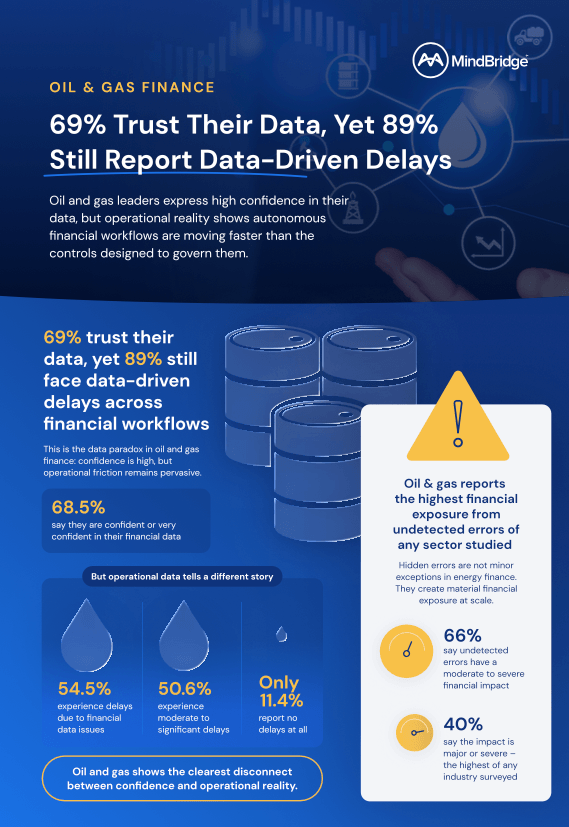
For finance teams, that friction has real consequences. Among respondents, 66% report moderate to severe financial consequences from undetected errors, with nearly 40% describing the impact as major or severe.
All too often, issues are caught much too late, only surfacing during audits, reconciliations, or regulatory reviews, when the financial impact may already be material.
Automation and the Visibility Gap
The oil and gas industry is accelerating investments in automation to improve efficiency and performance, with finance teams reporting clear value in using AI to reduce manual work and strengthen controls.
At the same time, automation can introduce new risk. As processes scale, visibility into individual transactions decreases, allowing issues that might once have been caught through manual review to move through systems undetected. Interestingly, 41.5% of survey respondents expressed concern that errors could go unnoticed as automation expands.
Rethinking Financial Oversight
Traditional control models, built on periodic review and sampling, were not designed for environments operating at this level of speed and complexity. As financial processes become more automated, risks increasingly emerge across systems and patterns, often becoming visible only after they have spread.
As a result, many organizations are beginning to move toward continuous monitoring of financial activity, with the goal of identifying issues earlier and maintaining control across the full transaction population.
For oil and gas CFOs, the challenge is no longer just trusting the data; it is maintaining control over how that data behaves across increasingly automated systems.
The question is not whether data issues exist. It’s whether your current controls can keep pace with the scale and speed of your operations. Download the full Oil and Gas survey infographic to see how leading finance teams are approaching continuous financial oversight in automated environments.