
The Governance Gap: Where Financial Risk Grows as AI Execution Accelerates 
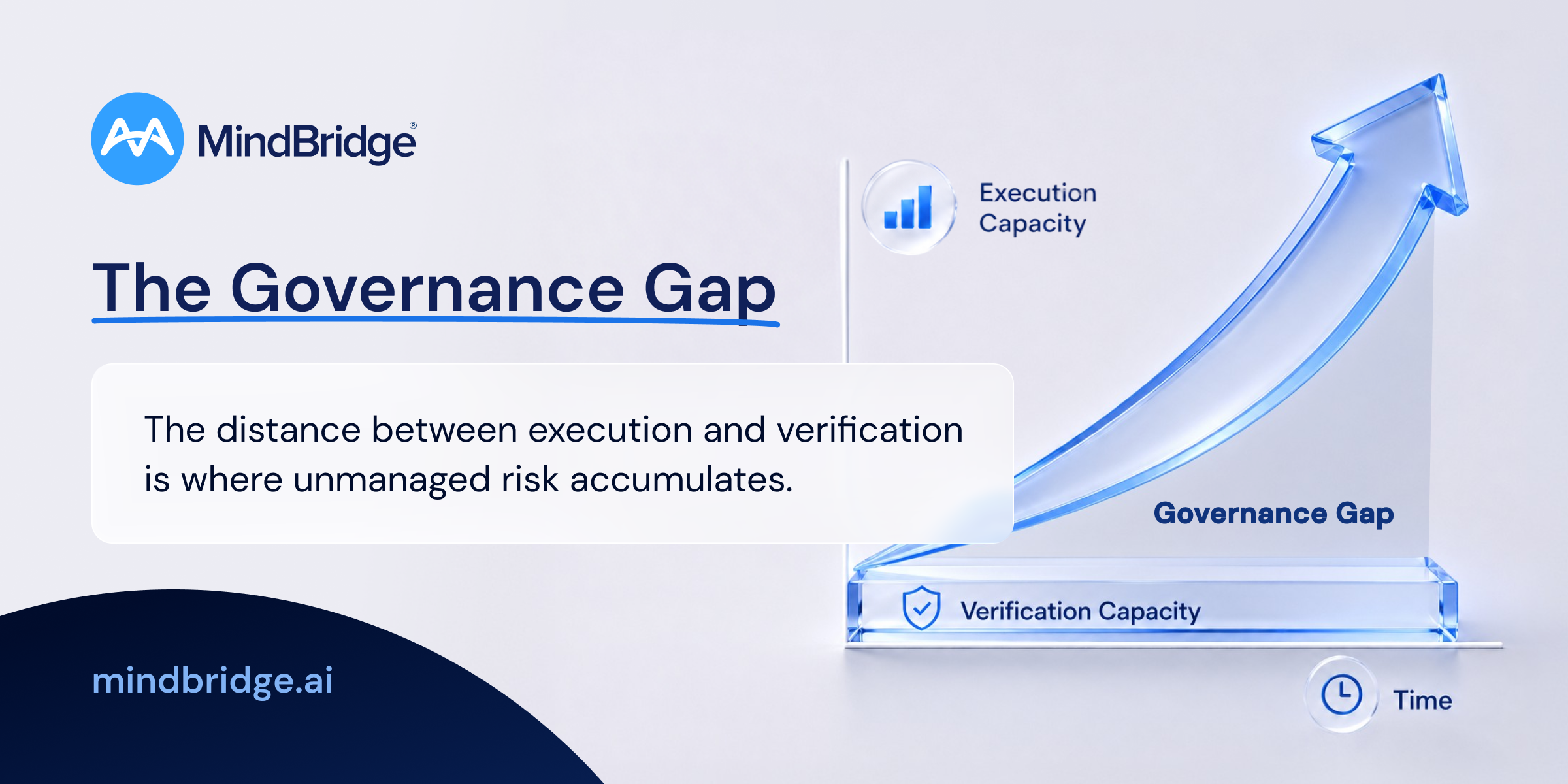
MindBridge Governance Gap diagram showing financial execution capacity rising over time while verification capacity remains flat, creating a widening gap where unmanaged risk can accumulate.

The workflow completed. Every approval passed. The numbers reconciled.  And the financial risk went undetected.  That is one of the more difficult challenges emerging as AI agents and automated workflows take on a greater share of financial execution. A transaction can satisfy every programmed rule and still contribute to a pattern of activity that threatens … Read more

As AI Takes Over Financial Execution, Who Verifies the Results? 

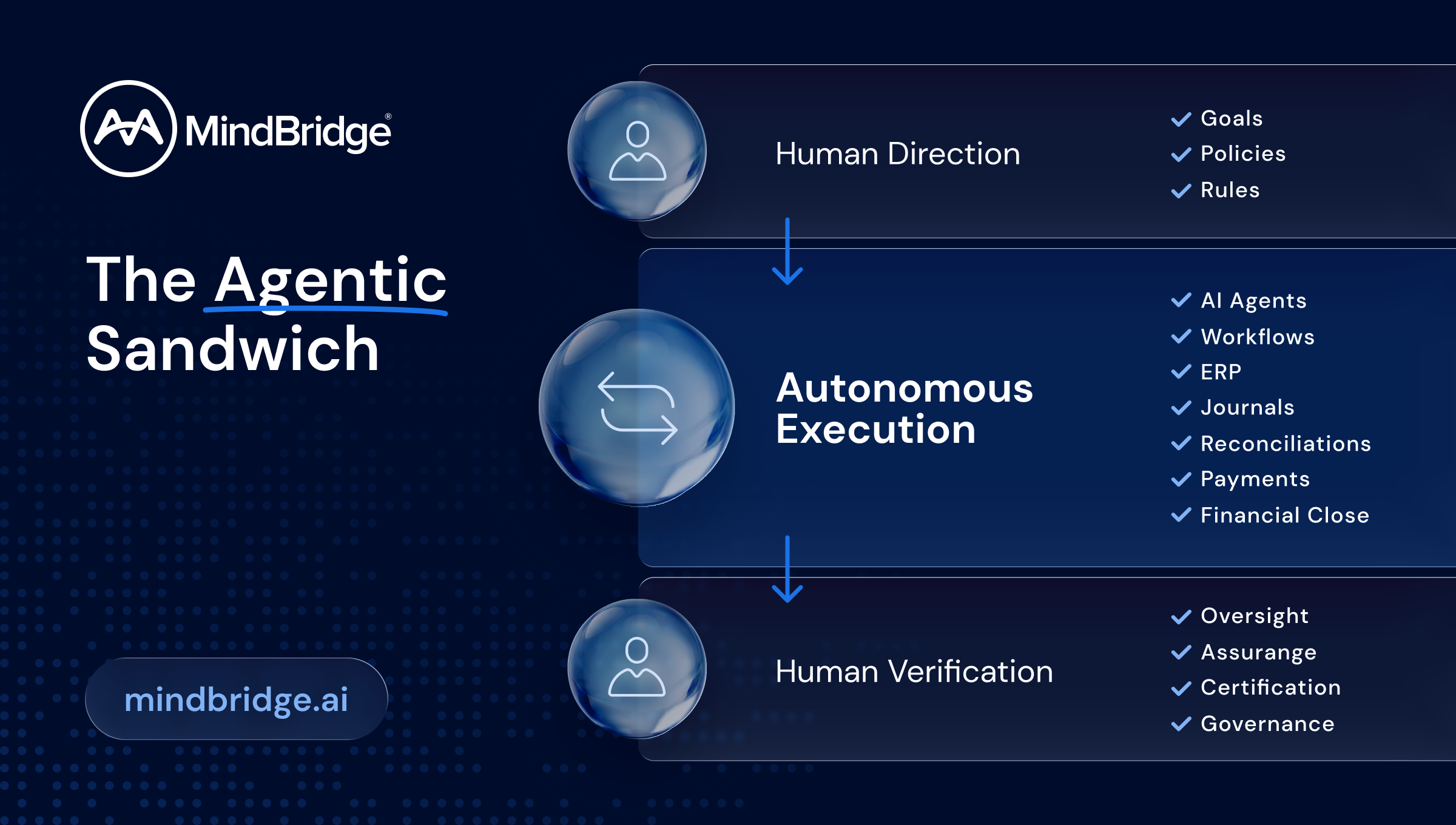
MindBridge Agentic Sandwich diagram showing human direction setting goals, policies, and rules; autonomous execution across AI agents, workflows, ERP, journals, reconciliations, payments, and financial close; and human verification providing oversight, assurance, certification, and governance.

AI is changing the division of labor in finance.  Work that once required people to create, classify, approve, reconcile, and route financial transactions is increasingly being handled by automated workflows and AI agents. SAP, Oracle, Workday, and other major systems of record are embedding these capabilities directly into financial processes.   That creates an obvious opportunity … Read more

AI in Finance and Audit: 5 Lessons from Vision 2026 

MindBridge Vision 2026, exploring AI in finance and audit

MindBridge Vision 2026 brought together finance leaders, accounting executives, audit professionals, AI governance experts, and technology leaders to examine the implications of AI for the future of finance and assurance.  Across the event, the focus was not simply on where AI can automate work, but on how organizations can govern it, maintain financial integrity, preserve … Read more

Why Sampling Breaks in Autonomous Finance 

Abstract illustration representing Autonomous Financial Oversight, with a glowing blue glass structure cracking apart to symbolize legacy financial controls breaking under AI-driven finance and the need for independent oversight.

For more than a century, financial oversight has relied on a simple idea: review a representative sample and infer the condition of the population. Audit standards, internal controls, internal audit, and external audit practices all evolved around that principle because they had to. No organization had enough people, time, or budget to inspect every financially significant transaction.  … Read more

Why Autonomous Finance Requires Independent Oversight

Why does autonomous finance require independent oversight? Learn how AI is changing financial execution, creating a governance gap, and driving the need for Autonomous Financial Oversight.

Over the past year, nearly every major enterprise software vendor has announced a new generation of AI capabilities for finance. SAP is expanding Joule across finance workflows. Oracle is embedding AI agents throughout Fusion Cloud Applications. Workday is introducing autonomous capabilities across the Office of the CFO. Microsoft is bringing Copilot deeper into the applications … Read more

Automation Is Accelerating. Your Oversight Isn’t. And You’re Still Accountable

AI in finance operations driving automated workflows and process automation across financial systems

AI in finance operations is not only changing how work gets done. It is changing how quickly decisions are made, how frequently they occur, and how far their impact can reach.  That shift introduces a new tension inside the finance function.  Execution is accelerating. Oversight, in most organizations, is not.  The pace of execution has changed  Financial … Read more