







Busy Season Didn’t Get Harder. The System Did. 

financial data analytics dashboard with charts and graphs used in audit and risk analysis

Busy season isn’t over, but by now, most teams have a clear sense of where the pressure is and why audit busy season challenges are starting to feel different. It isn’t just in deadlines, but in the work itself. There are moments where things can take longer to reconcile, where understanding can require an extra pass, and where getting comfortable with a result isn’t as immediate … Read more

Letting Data Speak: The Missed Opportunity in Audit and Assurance 

Discover how audit data analytics empowers firms to move beyond checklists, uncover hidden risks, and elevate audit quality with deeper insights.

Audit and assurance teams today are equipped with powerful tools, robust methodologies, and increasingly advanced audit analytics. From risk assessment to control testing to substantive procedures, data is embedded at every phase of the audit process. Yet, despite this data-driven approach, many teams find themselves asking the same question: Why aren’t we uncovering more? The real … Read more

Beyond the Black Box: What AI Assurance Really Looks Like in Audit 

Learn why AI assurance is becoming essential in audit. Explore how third-party validation strengthens transparency, governance, and audit integrity.

As artificial intelligence becomes central to audit analytics, one reality is becoming impossible to ignore: trust in AI can’t be assumed—it must be assured.  Audit and assurance professionals are under increasing pressure to adopt AI-powered tools, whether to meet efficiency demands, comply with evolving standards, or keep pace with market expectations. But beneath the surface … Read more

Internal vs. External Audit: Key Differences, Use Cases, and Strategic Alignment

Learn the key differences between internal and external audit—including goals, scope, and stakeholders—and discover how aligning both functions with AI can drive greater efficiency, insight, and assurance.

When it comes to protecting an organization’s financial integrity, both internal and external audits play critical roles. But they’re not interchangeable—and understanding their differences is key to maximizing their value. This blog breaks down the distinction and explores how modern audit teams are using AI to bring internal and external functions closer together than ever … Read more

Redefining the Role of the Auditor in the Age of AI

Discover how AI-driven audit automation revolutionizes the audit process with enhanced risk detection, continuous monitoring, and real-time compliance for scalable success.

Auditors have always carried the weight of trust—tasked with upholding financial integrity in an increasingly complex world. That responsibility hasn’t changed. But the environment auditors operate in? That’s evolving fast. Today’s audits don’t just face more scrutiny—they face a new scale of risk. Transactions happen in milliseconds. Data volumes have exploded. Fraud and errors have … Read more

AI-driven audit automation: streamlining processes for scalable success 

Discover how AI-driven audit automation revolutionizes the audit process with enhanced risk detection, continuous monitoring, and real-time compliance for scalable success.

As financial data grows exponentially, traditional audit methods struggle to keep pace with the sheer volume and complexity. In today’s fast-evolving regulatory environment, relying on periodic, manual audits leaves organizations vulnerable to risk. AI-driven audit automation offers a solution by allowing finance professionals and auditors to continuously monitor transactions, detect anomalies, and ensure compliance in … Read more

Revolutionizing accounting oversight: MindBridge’s next-generation anomaly detection 

The accuracy of financial data is not just an operational need but a strategic imperative. Clean financial data is crucial for reliable financial analysis, accurate reporting, and sound decision-making. Finance teams need to be the trusted source of truth. This allows the business to maintain consistent compliance, manage risks, and optimize performance in business operations … Read more

ISA 315 revised: What it means for risk assessment procedures, and data analytics

Two characters discuss the benefits of data analytics in light of ISA 315 revisions.

ISA 315 (revised) and Data Analytics: Risk assessment procedures reimagined

The revised standard has been published as of December 2020, and you might be wondering what impact it has on your firm’s risk assessment procedures and how you can address the requirements. There are many useful sources of information on the changes, notably the IAASB’s Introduction to ISA 315. IFAC also published a helpful flowchart for ISA 315 during the work programme, which walks through the various steps required to assess risk of material misstatement.

There are a number of improvements to the standard, including an enhanced focus on controls (particularly IT controls), stronger requirements on exercising professional scepticism and documentation, and considerations around the use of data analytics for risk assessment. The new standard comes into effect from 15th December 2021, so now is the time to start planning how you will address the changes in your audit. Below we discuss some key considerations on how analytics can support a strong risk assessment.
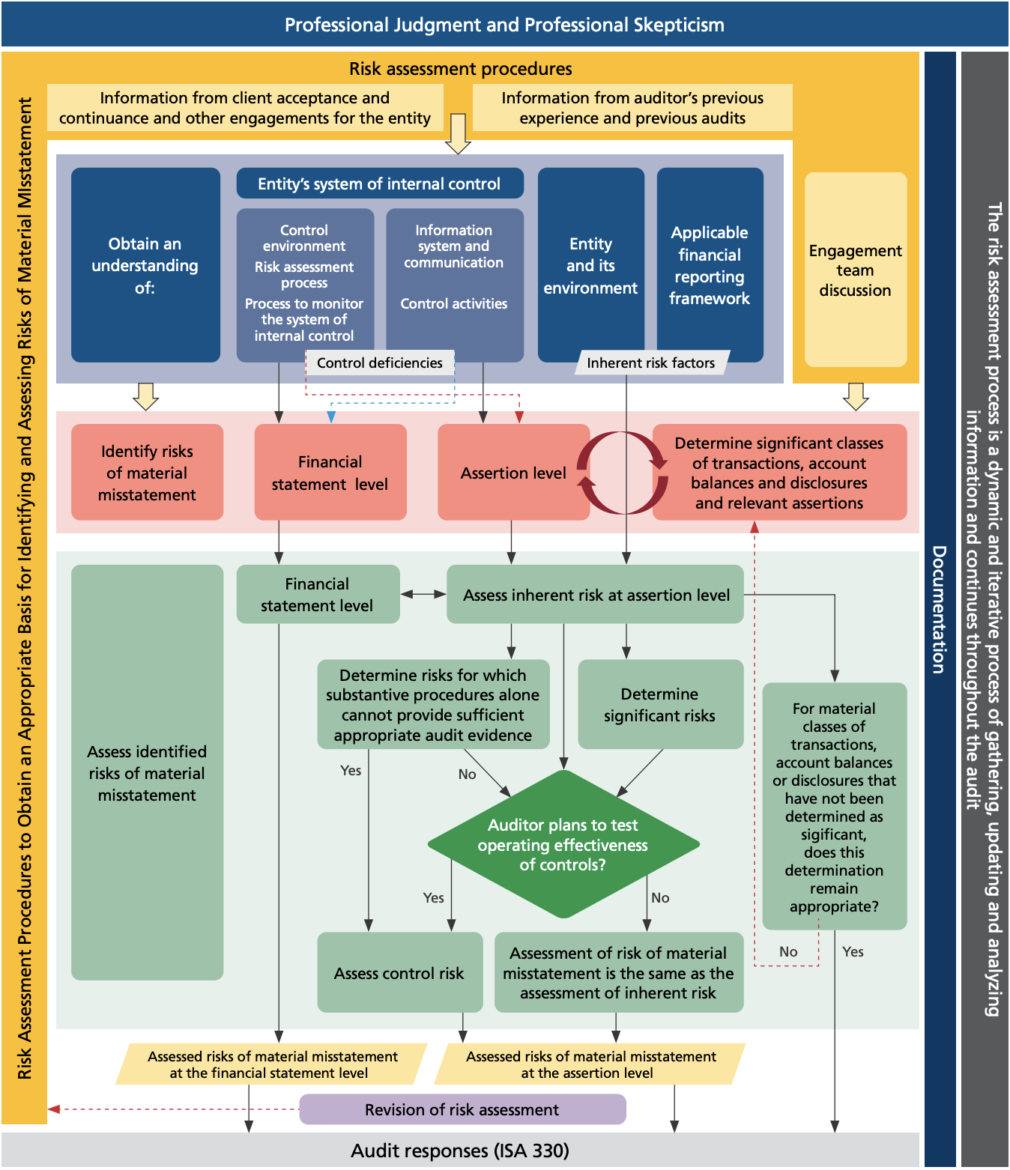
A chart explaining risk assessment and data analytics as part of the ISA 315 revision by IFAC.

Credit: https://www.ifac.org/system/files/publications/files/IAASB-Introduction-to-ISA-315.pdf

So how can data analytics support your risk assessment according to ISA 315? The areas identified above in red show the different procedures that can be supported by the use of these techniques. A key element of the revised standard is that this should be an iterative process conducted throughout the audit. This means using data analytics tools that can be easily refreshed with the latest information will better support this requirement than more traditional approaches.

Identifying risks of material misstatement at the financial statement level

Data analytics can support the risk assessment procedures laid out in ISA 315 by analysing previous and current accounting data to the financial statement level. This allows the auditor to see the material balances in the accounts, and if machine learning is applied, where the concentration of risky transactions lies. This is where the knowledge gained in the blue boxes above can be brought to bear. Comparing understanding gained through observation to the data is a powerful way to sense check and identify areas for further investigation.

Identifying risks of material misstatement at the assertion level

Specific analyses can target assertion risks and show where there are particular problems with an assertion. To do so effectively, several different analytics tests can be applied and combined to develop a good indicator of an assertion risk, for example accuracy. These can then be applied in an automatic way to give the auditor the information needed for their risk assessment.

Determine significant classes of transactions, account balances or disclosures (COTABD)

Combining assertion analytics with the ability to profile similar transactions can help auditors identify significant classes of transactions or balances. Analytics can help to produce similarity scores, but also to identify sets of transactions that are unusual. This can indicate previously unknown business processes that may require a separate assessment of their control environment.

Assess inherent risk by assessing likelihood and magnitude

Following identification of risk, the audit can guide their assessment by understanding the level of unusualness. Data analytics can provide finer grain evaluations of risk rather than simply risky or not. This can help support assessments aligned with the spectrum of inherent risk as defined in the standard.

Assess control risk

Data analytics such as process mining or automated testing of segregation of duties can help to inform or test control risk. These analytics can provide more comfort around the controls risk assessment and help to identify deviations in the control environment that require further examination.

Material but not significant COTABD

Where COTABD has been determined as material but not significant, recurring analytics can ensure that this assessment remains valid. Anomaly detection methods can be particularly helpful here, allowing the auditor to regularly check that nothing unusual has occurred since the initial assessment was undertaken.

Next Steps: ISA 315 and Data Analytics

Audit methodologies will need to reflect the revised workflow, with particular emphasis on the iterative nature of the risk assessment and ensuring that auditors are prompted to exercise professional scepticism and document it at every stage. Data analytics can help to ensure that the information used to continuously conduct risk assessment is timely, appropriate and relevant.

These improvements to the standard will result in a stronger audit approach and an advancement towards industry adaption data and analytics technologies. With AI audit software, accountants and auditors can gain deeper insights into their client’s financial data, in less time. Overall, the audit software can increase the efficiency of their processes, so they can focus on delivering better results, in time for the ISA 315 (revised) December 15th, 2021 deadline. 

Want to learn more about the benefits of AI auditing software? Read our article on “Assessing audit risk during engagements” to learn more. 

Want to learn more about how auditors are using AI?

Leveraging AI for your substantive procedures for Accounts Receivable and Accounts Payable

abstract lines up showing ar-ap procedures

Artificial intelligence (AI) and machine learning (ML) technologies can streamline traditional audit procedures for Accounts Receivable (AR) and Accounts Payable (AP) in audits of financial statements.

This blog will consider applications of AI and ML technologies using the MindBridge platform for both substantive analytical procedures as well as detailed testing of specific items.

What does the MindBridge platform do?

MindBridge Ai Auditor, in addition to core general ledger analysis, includes dedicated AR and AP modules that automatically analyze subledger data and, without any scripting, provide high-value visualizations and transaction-level analysis of data.

These capabilities allow you to leverage subledger-level insights and anomalies as critical inputs to your audit procedures and identify risks of material misstatement.

How MindBridge empowers you to perform effective and substantive analytical procedures for AR and AP

Substantive analytical procedures can be a powerful complement to traditional sampling and external confirmations. That is, provided that the auditor is comfortable with the internal controls in place regarding purchasing and sales cycles and has validated the accuracy and completeness of the subledger data.

Trends and patterns

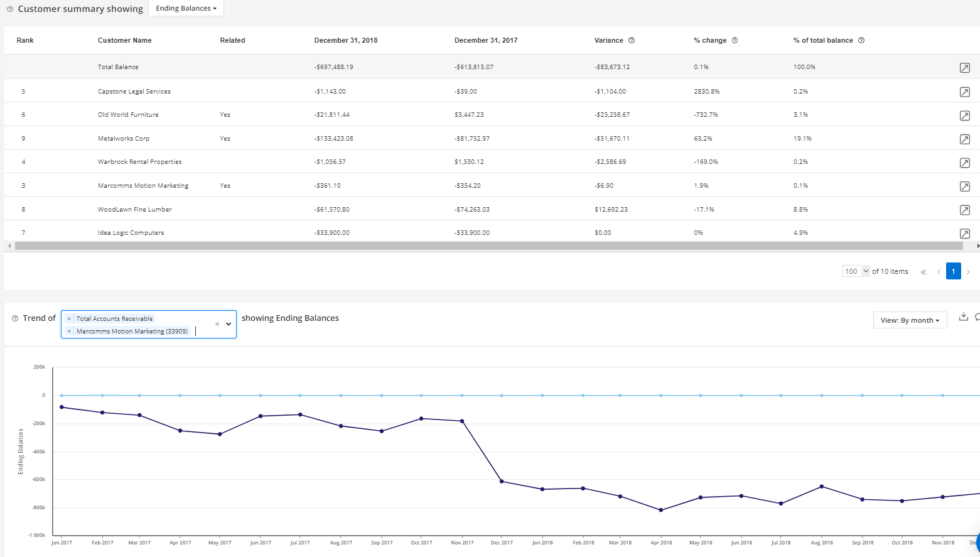
Ai Auditor allows you to visualize how monthly AR and AP balances or net monthly activity track over multiple years at customer vendor levels, and in aggregate. Consistent patterns in these trends in the face of consistent sales and purchasing patterns (respectively) may provide audit evidence that subledger information is not materially misstated.

Vendors and customers related to the entity subject to audit are flagged directly in the summary detail as well.

AP AR screenshot showing summary detail

Key performance indicators

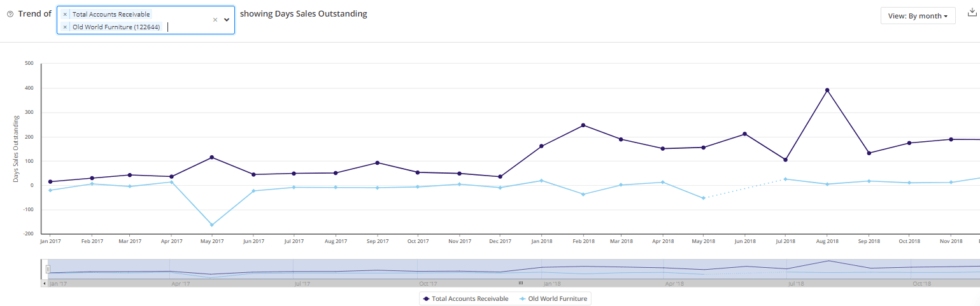
Days Outstanding and Turnover Ratios are calculated at the customer and vendor level and are visualized on a monthly basis, allowing you to identify where there are periods of potential distress or deteriorating quality (e.g. is the volume of cash receipts slowing?). Similar to ending balances and activity, you are also able to compare certain customers or vendors against each other along the lines of these metrics to expose patterns of interest.

Key performance monthly indicator screenshot

Aging

Aging at the customer and vendor level is automatically calculated and captured across respective buckets of days outstanding (0-30 days, 31-60 days, etc.). Consistent breakdown in the relative proportion of these aging buckets across multiple years of subledgers may provide audit evidence that subledger information is not materially misstated at the balance sheet date.

For certain entries that are significantly aged or stale, you’re able to drill-in to all the transactions with a particular customer or vendor and ascertain which invoice(s) are contributing to those totals and whether they could be at risk of bad debt.

Risk of bad debt screenshot

How MindBridge streamlines detailed testing of AR & AP subledger data

Navigating and querying transactional level data via the Data Table in Ai Auditor is a powerful and effective way to explore and validate subledger activity.

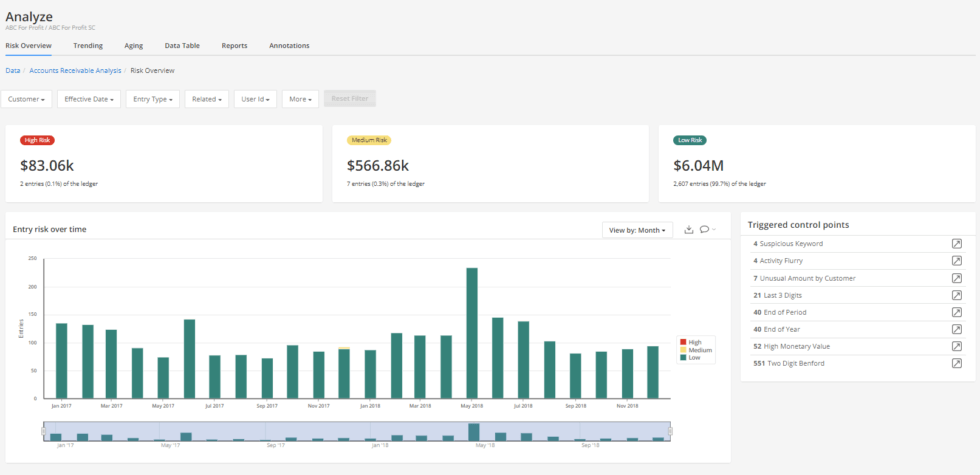
Control Points, which are various statistical, rules-based, and machine learning tests, are run against every transaction. The results are summarized on a dashboard that supports interactions like filtering and drill-through.

Dashboard based on control point screenshot

Combining the query building capabilities of the Data Table with Control Point tests, you can efficiently identify relevant populations for sampling and have selections for external confirmation requests or alternative procedures testing (like subsequent receipts, for example) automatically identified on a risk-stratified basis. These selections can then be exported to Excel in one click  to populate confirmation requests and/or to be included in supporting documentation.

The results of the transactional risk analysis may also be of particular interest to large entities and small businesses alike to provide insight into where there may be process improvements or gaps to consider in internal controls.

Take the first step towards AI-driven audit procedures on the AR and AP subledgers

To learn more, contact sales@mindbridge.ai.

Want to learn how AI can empower finance leaders of the future?