


Financial automation: The good, the bad, and the future

Financial automation: The good, the bad, and the future | MindBridge

Well, it’s finally here. According to an article from Forbes Magazine, we have reached the age of automation. From AI and machine learning to financial automation and robotics, we’re officially an automatic civilization. Please, be kind to our new robot co-workers.

Okay seriously, this is important stuff, even if we did all see it coming. Especially when it comes to the ever-expanding world of finance.

In every industry, every business, and every firm, finances and how they are managed are vital to the growth and development of a company. Whether you’re a business owner, CFO, or part of the finance department, the role of automation in the future of finance is vital to your role, growth, and the evolution of your organization.

Financial automation doesn’t just mean automating payroll, although it doesn’t hurt to do that as well. Automating financial processes incorporates much more, including risk assessment, audit, and compliance among many other aspects.

An article from DigitalistMag outlines the capabilities of today’s financial automation services, describing the ability to “gain new insights from existing data to optimize credit decisions and improve financial risk management, automating business processes that previously required manual human intervention, and improving the customer experience.”

Financial management has evolved rapidly since the advent of computational technology. As this technology evolved, financial experts and professionals soon recognized that process standardization and centralization are absolutely necessary to increase the efficiency and effectiveness of modern organizations. As efficiency grew into a central tenant of management processes, financial automation became the next logical step for businesses and organizations.

In 2016, McKinsey estimated that 60% of all occupations have approximately 30% or more capabilities that can be automated with existing technology. Moreover, there has been a significant change in the understanding of what can be automated and what should be automated, which has become increasingly evident due to the unprecedented effect the COVID-19 pandemic has had on work

For businesses looking to hire and outsource their financial processes or professionals who want to simplify and streamline internal processes, it may be time to look at automating them instead. For many, this has already begun, as “CFOs around the world heavily invest in financial automation software as a next step in the evolution to enable enterprise transformation.” 

In this way, financial automation could lead to a complex or fundamental shift in how an organization’s core business is conducted.

Taking the first step toward financial automation can seem daunting. However, with more businesses adopting automation into their day-to-day financial practices, it’s clear to see the power this technology holds.

So, what exactly is financial automation?

What is financial automation?

For us mere mortals, financial automation can be as simple as automatically depositing your paycheck, paying bills, or saving a portion of your income per month. The concept is similar for businesses and corporations, but at a much larger scale, and with a lot more moving parts.

Financial automation is the process of utilizing technology options to complete tasks with minimal human intervention. These tasks would normally be accomplished by employees, which, in theory, frees up time for them to perform more complex tasks. 

According to another automation study from the McKinsey Global Institute’s automation research, current in-use technologies can fully automate 42 percent of finance activities and mostly automate a further 19 percent.

While many still consider financial automation and intelligent software to be on the horizon, organizations have already started to utilize cutting-edge tools and technologies such as advanced analytics, process automation, robo-advisors, and self-learning programs. A lot more is still yet to come as technologies evolve, become more widely available, and are put to innovative uses.

Levels of automation

The initial forms of automation were (and still are) macros and scripts: simple rules-based automation that repeated simple work with highly structured data –  things like general accounting operations, revenue management, and cash disbursement have an over 75% fully automatable ability with already existing technologies.

Robotic process automation (RPA)

RPA is the basis (above macros and scripts) to understand the capabilities of automation. An example of an RPA would be simple software that can perform repetitive tasks quickly with minimal effort, like some of the rote tasks mentioned earlier. 

According to the 2017 McKinsey research (also mentioned earlier), about a third of the opportunity in finance can be captured using basic task-automation technologies such as these.

Artificial intelligence (AI) and intelligent automation (IA)

On the other end of the spectrum is artificial intelligence. Artificial intelligence is theoretically achieved when software is able to make intelligent decisions while still complying with controls using algorithms or machine learning

Machine learning algorithms demonstrate the ability for computers to take in a constant stream of data, analyze that data for patterns and recommend solutions to problems humans can’t even see, proving vastly positive results in improving a company’s financial proficiency.

Once a dream for financial professionals and business owners, this form of financial automation software is becoming a reality, shaking up the way that tasks are performed, and even introducing other aspects such as forecasting into the mix.

Improvements with financial process automation 

The umbrella of finance – from payroll to predictive forecasts can involve menial and repetitive tasks which leave limited time and resources to focus on value-adding activities to grow your organization. When financial process automation is added, it serves as a pivotal support to free up needed resources and time. 

As these technologies can cover more ground and more deeply analyze company financials, many organizations are finding that AI and automation technologies are actively improving their bottom line. According to a survey from the Association of Certified Fraud Examiners via the Harvard Business Review, “organizations lose 5% of their revenue every year due to fraud. The typical fraud case causes a loss of $8,300 per month and lasts a full 14 months before detection. And lack of internal controls contributed to nearly one-third of all fraud cases.”

Risk discovery is just one aspect of financial automation, but a growing one.

As AI, RPA and IA continue to use machine learning to do more and perform more intricate tasks, offering insight into finances, we are seeing how this can be incorporated into an organization’s long-term organizational strategy. MindBridge, for example, has developed AI technology for risk discovery, a complex financial task that incorporates not only transactional analysis, but offers broader insights into financial health and integrity.

Want to learn more about how auditors are using AI?

By automating certain financial processes, “finance professionals can not only provide real-time insights into the current status of the business but, with advanced predictive algorithms, they can look into the future and proactively steer the business.”

Financial automation and its capabilities are excelling at a fast rate. With the help of AI, RPA, and IA, standard automation practices can be enriched beyond simple pre-programmed controls and scripts. From McKinsey & Company once again, AI algorithms can learn from historical datasets and the interactions of the financial professional with the system, thereby improving the matching rates tremendously. In this context, matching rates refer to the ability at which an AI system is able to tag users to certain data sets based on their profile of demonstrated usage. Furthermore, the AI technology allows automatic extraction of unstructured information from documents, such as emails.

Of course, return on investment is always a concern. It can take a lot of time and effort to implement new technologies, and savvy business leaders need to know that the tools and processes they put their money behind will work. 

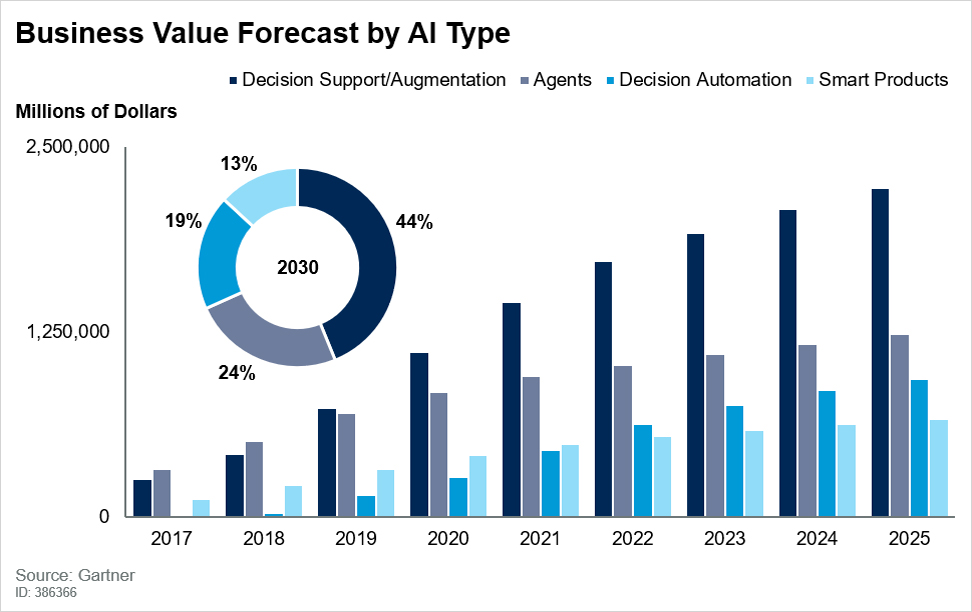
According to Gartner, “AI augmentation will create $2.9 trillion of business value and 6.2 billion hours of worker productivity globally.” Basically, they define this term as the combined work of humans and technology, with the people at the center of the operation.

business value forecast by AI type | Graph
Source: Gartner.

If these forecasts are correct, executives should be clamouring for AI and automation investment. Even a small piece of this pie can level up your office, department, or organization writ large.

What financial process automation could mean for work structure

One of the biggest concerns associated with exploring financial automation and therefore implementing financial automation software is what happens to the employees and the roles formerly associated with those finance objectives. 

There’s no doubt that introducing financial automation will change the roles of many employees and even the manner to which employees are trained or progress toward career objectives. One thing is for sure though, automation will replace low-value, simple, and time-consuming tasks, thereby giving staff the flexibility to expand their roles, and spend more time on value-adding activities to help drive a company’s competitive advantage. 

In an article from PWC on change management, they outline five steps that can help firms adopting financial automation make the transition as smooth as possible:

  • Prepare for human capital risks like you’d prepare for any other risks
  • Help people find their way
  • Create organizational support for success
  • Expect changes to jobs, compensations, and structure
  • Learn new ways to develop your team

To unlock financial automation’s full potential, managers must be willing to re-engineer processes, and redeploy resources to optimize efficiency and output.

Another consideration for anyone looking to adopt automation and AI technology is assurance and verification. This verification work ensures that the technology in place is doing what it’s supposed to do, at the level of work required to meet compliance requirements and quality assurance standards.

Internal teams can “test” automations by utilizing what are known as “Test Frameworks” for applications. Some examples of framework tools come from SmartBear and Selenium. However, it’s a lot of work, and unless you have dedicated developers that can help your team test automation tools, you’re sort of stuck. For many businesses, it’s much easier to work with platforms and tools that have done this testing themselves by utilizing a third party.

A future with financial automation

Although IA and machine-learning algorithms are still considered in their infancy, that doesn’t mean finance leaders should wait for them to mature fully. According to McKinsey, many automation platforms and providers that struggled a decade ago to survive the scrutiny of IT security reviews, are now well established, with the infrastructure, security, and governance to support enterprise programs. “Where a manager once had to wait for an overtasked IT team to configure a bot, today a finance person can often be trained to develop much of the RPA workflow.” The exponential growth in structured data fueled by enterprise resource planning (ERP) systems, combined with the declining cost of computing power, is unlocking new opportunities every day.

MindBridge is a great example of a pioneer in unlocking the expanded capabilities of AI and RPA within the finance sector. With AI-embedded risk discovery, MindBrige can risk-rate 100% of the transactions in general ledger and sub-ledgers to produce an aggregated risk profile of the data that makes up the business’ financial statements, facilitating laser-like focus on the areas that matter.

The future of financial automation seems bright, already beginning to reshape the way in which financial services are performed in organizations large and small. Incorporating AI, RPA, and other forms of automation can seem daunting at first, as there are many tasks and organizational changes that go into implementing new technologies and processes. 

By empowering your finance team with AI co-workers, they reduce the time spent on mundane tasks, enabling your team’s human intelligence to shine operationally. Financial efficiency and accuracy means happy stakeholders, and a growing business. What’s not to love?

For more articles like this one, visit our Resource Center.

AI in finance: Helping professionals shift from hindsight to insight to foresight

Stopping dominoes with foresight

We are facing an unprecedented time of global uncertainty created by the COVID-19 virus that has unleashed a global healthcare crisis. Humanity is fighting a war against an invisible enemy that is attacking humans around the world and sparing no country. We need not be pessimistic or optimistic but rather realists and learn from the history of humanity. Human ingenuity will prevail, and humanity will survive.

We have entered a new world after COVID-19 with very different assumptions than we had in the old world when the world GDP yielded a record high of $85T. The world GDP has been severely impacted by the lockdown stipulations that were imposed to minimize the spread of the virus within the population. The key pillars of the economy are consumer and companies’ spending. If this slows down, it can lead to a recession and even depression. The lockdown restrictions are being relaxed and governments and central banks around the world are injecting massive amounts of funds into the hands of individuals and companies in an effort to reopen the economy to avoid an economic crisis.

How can artificial intelligence in finance help organizations pull through?

A renewed focus on financial errors

During economic uncertainty, an added vigilance is needed by those responsible to ensure the accuracy and integrity of the financial records that are being relied upon to make decisions about the operations of their organizations. A report by the Association of Certified Fraud Examiners (ACFE) “2020-Report to the Nations”- 2020 Global Study on Occupational Fraud and Abuse estimates that the yearly cost to the world due to fraud and abuse is about $4.5T or 5% of the world GDP. They examined over 2500 cases from 125 countries with combined losses of $3.6B with an average loss by case of $1.5M and a typical case lasting 14 months before being detected.

Whereas corruption was the most common type of fraud, the most costly were financial statements fraud schemes, even though they represented only 10% of the cases.  The breakdown of the detection methods reveals that analytics plays only a small role in the detection of occupational fraud: Human tips; 43%, internal audit; 12%, management reviews; 5%, by accident; 5%, whereas external audit catches only 4%.

A 2019 survey by Blackline provided insights into the concerns by executives with inaccuracies in financial data. With over 1100 C-suite executives and finance professionals from mid- to large-size organizations around the world, the white paper stated that:

“55% are not confident that they can identify financial errors before reporting results, 70% claim that their organizations made a significant business decision based on inaccurate financial data and 26% are concerned over errors that they know must exist but they have no visibility”.


The power of AI in finance

Finance professionals that rely on outdated tools and methodologies do not offer the best visibility into finding errors, errors with intent, errors that are considered fraud, and general mismanagement of the financial dataset in their organizations. The world is already witnessing a major trend toward moving to the cloud and becoming digital native and these must be vigorously pursued by organizations that want to be of the forefront of growth post the crisis.

Becoming digital native enables companies to move towards a near real-time view of their financial data and, coupled with AI in finance functions, the ability to fully analyze 100% of transactions. This ensures transparency to key stakeholders such as board members and auditors and aids in the identification of any anomalies in their financial records.

Currently, a company’s financial records are examined by external auditors on a yearly basis and evaluated using a sampling method that leaves the bulk of the dataset untouched. This method of rear view-mirror assessment provides C-suite executives with a hindsight perspective and the fear that decisions are made based on inaccurate and untimely information. Using AI-based tools to review 100% of the financial records in near real-time offers C-level executives with insights into data and, by using the appropriate analytics built into the AI applications, offers foresights into the operations of the company.

The two most important behaviors that companies must have to thrive post COVID-19 are resilience and adaptability. Resilience is defined as the ability to withstand or recover quickly from difficult conditions whereas adaptability is defined as the quality of being able to adjust to new conditions. Companies must build their operations and culture around resilience and adaptability so they can work efficiently during the “new normal” when we emerge out of this dark tunnel will become stronger and better off.

An article published by the Boston Consulting Group titled “The Rise of the AI-Powered Company in the Postcrisis World” highlights the tremendous opportunity for companies that are going to digital native, moving to the cloud, and adopting AI in finance applications to supercharge their operations. Arvind Krishna, in his inaugural speech as IBM’s new CEO, said, “I am predicting today that every company will become an AI company – not because they can, but because they must. Digital transformation means putting artificial intelligence at the center of workflows, and using the insights generated from that process to constantly improve products and services.”


Embracing technology as a CFO in 2020

internal audit and risk

CFOs continue to be one of the most important resources to their business. In the last 20 years or so, they have spent countless hours working through regulatory and reporting changes, implementing new systems, and partnering with other leaders in the business on analytics. Through all this, they also have to come up with new ideas to find funding and preserve revenue streams, and maintain the fiscal discipline that CEOs and boards have come to expect.

How can CFOs and their teams balance these needs against higher fiscal scrutiny, cost cutting, and changing work environments?

The answer is to bring longer-term thinking up front, to measure, plan, and execute on our new environment now and get comfortable with the new normal.

CFOs here and now

Many companies are shedding resources and re-aligning their operations to protect their core business, while also hoping to make themselves indispensable to clients. Some are successful while others are struggling to adapt and find themselves trying new ways to look at cash flow, going concern ratios, and most importantly, customer engagement and retention.

This is only natural as the global economic slowdowns and supply chain uncertainties mean that CEOs and boards are tasking CFOs to review all expenses. These short-term projects start with salaries and travel expenses and follow with software subscriptions and other suppliers. While these are good actions to take, they don’t necessarily prepare the organization for the new normal, when people are returning to work, supplies start shipping again, and customer expectations have shifted.

CFOs must build a longer-term strategy into their short-term goals.

Another key consideration is the rise in fraud. According to the latest ACFE Report to Nations 2020, we know that up to 5% of top line revenue is lost to fraud around the world. There’s an expectation that COVID-19-related business and personal stressors will eclipse that figure quickly if we’re not careful.

To evolve beyond the short-term and reactive decision making now, organizations must buckle down and work through their long-haul strategies. From a CFO perspective, this could be:

  • Assessing the level of granularity on reviews and reports
  • Identifying areas of the business to trim or reduce
  • Determining any new risks for the organization to consider
  • Understanding how quarterly reporting, audit, and governance cycles will change

Preparing for post-crisis business operations

As former CFO, Shaye Thyer, posted on LinkedIn: “I would have given my left leg to have access to some of the amazing tech we have now.”

It’s not easy for business leaders and their teams to shift to the new normal and that’s where strategies, people, and tools must come together.

How does this differ from leadership advice in the past?

Rather than focus on reactive measures that use traditional processes and historical data, leaders must plan and strategize updates to their finance organization that take advantage of today’s unique opportunities to outpace the competition. This also means understanding the changed expectations of employees working in a different environment to keep them satisfied, motivated, and productive.

This could mean taking stock of internal remote working situations, and that of clients, to build them into new strategies. Augmented working environments open up a wealth of opportunities for collaboration, communication, and value creation. As this Forbes article states, returning the 2.7 billion people affected by lockdowns and stay-at-home measures could mean that, “While some employees will return onsite, others may continue to work remotely or engage in a hybrid model. In addition to arming workers with the skills and access needed to meet work requirements, re-engaging the workforce will involve assigning meaningful work.”

A big piece of this puzzle will be tools that adapt to these shifts in working models and leverage those changes to open up new opportunities. Moving to a digital-first strategy is key, as it will help teams collaborate better and remove as many manual steps as possible. This should cover everything from payables and receivables processes, such as getting all contracts signed digitally, to working on the assumption that travel will be limited.

Some offices are moving away from physical locations to hybrid models or even full remote working. Whatever each firm decides to do, there’s no question that professions are changing:

“Three elements of our practice have changed forever: the unprecedented move to a virtual practice, the client experience and our relationships with traditional office real estate.”
– Gary Shamis for Accounting Today

The bottom line for CFOs

To prepare for the new normal, I recommend these steps:

  1. Perform a full review of your tech stack and tools to see what needs to change for a post-COVID business model. This includes seeing where AI can fit to empower your teams and bring value.
  2. Start thinking digitally and how to support vendors, customers, and other stakeholders that are making their moves now.
  3. Prepare for a new way of working together on financial reporting from a distance, and evolving audits to be completely “touch free”
  4. Identify risks, especially potential fraud opportunities, and shore up the team with tools that augment their data assessment capabilities and provide deeper insights than traditional descriptive analytics technology

Since my start in this space over 20 years ago, we’ve had a number of times where we’ve relied on the CFO more than any other C-suite executive. This time around, we need to augment the Office of the CFO with state of the art technology, new normal of workplaces (virtual or not), and trust the professionals to take us into new strategies. We need to continue to be lean, execute extremely fast, and ensure that our strategy includes insight-driven tech (such as AI) and become digital in all that we do.


To see why finance teams trust MindBridge, watch this 4-minute video now